Momentum Investing in India: A Practical Guide for Retail Investors
The Way Most of Us Think About Investing

Most people enter the stock market believing the real money comes from finding something early.
- The hidden small-cap nobody is discussing yet.
- The stock tip before it becomes public.
- The “next multibagger” before finance creators start making thumbnails about it.
That idea is everywhere now.
Open YouTube and someone is explaining why a stock could double. Scroll Twitter and there’s always a thread about “undervalued opportunities.” Spend enough time around market content and eventually it starts feeling like everybody else already knows something you don’t.
And honestly, that feeling pushes investors into bad decisions more often than they realise.
Because predicting future winners consistently is extremely difficult. Not just for beginners. Even professional fund managers with years of experience struggle to do it reliably.
Momentum investing takes a very different route.
It doesn’t really ask: “What could become successful next?”
It asks: “What is already showing strength right now?”
That sounds almost too simple initially. But there’s a reason the idea has survived across different markets for decades.
Most Indian homes have had a matka somewhere during the summer.
An earthen pot sits quietly in a kitchen corner with cool water inside. No electricity. No fancy system. Just clay and water doing what they naturally do.
The matka isn’t trying to predict tomorrow’s temperature. It simply responds to what’s already happening around it. Water slowly evaporates through the surface, the temperature drops, and the cooling happens steadily over time.
Markets behave a bit like that too sometimes.
Momentum investing doesn’t try to guess which stock will suddenly explode next month. It pays attention to where strength already exists and follows that direction while the trend remains healthy.
And markets, for whatever reason, often reward that persistence longer than people expect. A stock moving up steadily keeps attracting attention, capital, analyst coverage, institutional buying, and retail interest. Not forever. But usually longer than logic alone would suggest.
And honestly, markets can stay irrational far longer than retail investors stay patient.
So What Exactly Is Momentum Investing?
At its core, momentum investing is built around one simple observation:
Stocks that have performed strongly in the recent past often continue performing well for some time, while weak stocks frequently stay weak longer than investors expect.
This goes against what many beginners hear initially.
“Buy low, sell high” sounds sensible. And in theory, it is. But markets are messy in real life. Cheap stocks can remain cheap for years. Sometimes they become even cheaper while investors keep averaging down hoping for a turnaround.
Meanwhile the “expensive” stock everybody feels scared to buy keeps climbing another 40 percent.
And honestly, markets don’t always care whether something looks cheap on paper.
Momentum investing accepts this behaviour instead of fighting it.
Rather than trying to guess where value might appear eventually, momentum strategies follow existing strength and rotate away once that strength weakens.
That doesn’t mean fundamentals stop mattering. Good momentum investing usually works better when price strength and business quality exist together. Otherwise it becomes speculation dressed up as strategy.
Why Momentum Investing Connects With So Many Indian Retail Investors
Indian markets have become extremely emotional over the last few years.
A stock trends online, and suddenly everybody wants exposure. Finance creators start discussing it. Telegram channels circulate targets. WhatsApp groups become full-time research desks overnight.
By the time many retail investors finally buy, most of the easy move has already happened.
Then the correction comes. The same stock that looked unstoppable suddenly falls 15 or 20 percent, and now people are searching the internet trying to decide whether they should panic-sell or “hold with conviction.”
That cycle repeats constantly.
A lot of retail losses don’t happen because people picked terrible companies. They happen because emotions interfere with timing. Buying too late during excitement. Selling too quickly once fear shows up.
Momentum investing helps partly because it replaces emotion with rules.
The question stops being: “Do I feel confident about this stock today?”
And becomes: “Does this still fit the strategy?”
That shift changes how many investors react during volatile phases.
A Simple 6-Month Momentum Strategy
One of the most common momentum approaches is surprisingly straightforward.
- Start with a broad stock universe
Usually something like Nifty 200 or Nifty 500. The idea is to work with reasonably liquid companies instead of highly illiquid small names.
- Rank stocks by 6-month returns
Look at how stocks performed over the last six months and rank them from strongest to weakest. No complicated prediction model. Just relative strength.
- Select the strongest performers
Choose the top-performing stocks from the ranking. Some investors prefer concentrated portfolios. Others spread across more names. There isn’t one perfect number here.
- Rebalance periodically
Every month or quarter, rerun the ranking. Stocks losing momentum exit the portfolio. New stronger stocks replace them.
That process sounds almost boring when explained plainly. Which is partly why many investors ignore it initially. But boring systems followed consistently often outperform exciting decisions made emotionally.
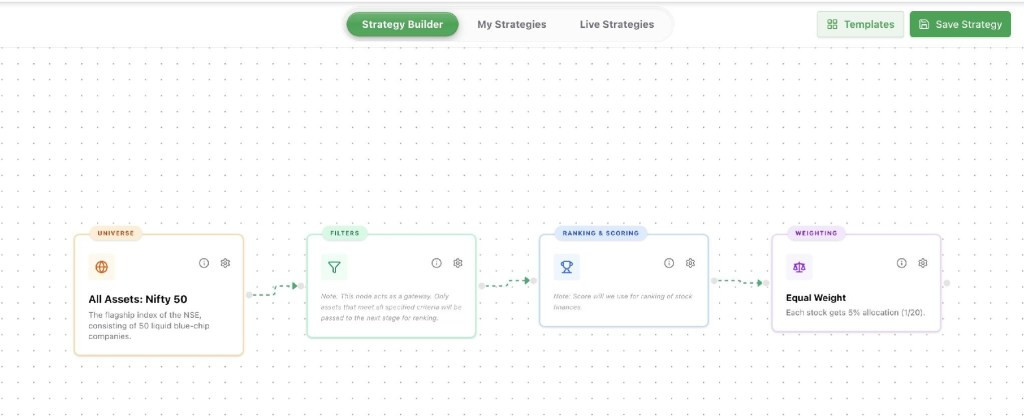
Kalpi’s Strategy Builder — define your universe, apply filters, rank by factors, and set weighting in one visual flow, no coding required.
Momentum vs Emotional Investing
| Situation | Emotional Investor | Momentum Investor |
|---|---|---|
| Sharp stock fall | Panics and starts searching opinions online | Checks whether the strategy rules changed |
| Trending stock everywhere | Buys late because everyone else is entering | Waits for confirmation from the system |
| Market correction | Reacts emotionally to headlines | Rebalances according to predefined rules |
| Strong earnings announcement | Notices after most of the move already happened | Often already positioned earlier |
What Momentum Investing Is Not
Momentum gets misunderstood constantly. Worth clearing up a few things.
It is not blind hype-chasing
People sometimes confuse momentum with simply buying whatever is trending online.
A stock discussed heavily for three days because of social media excitement is very different from a stock showing six months of consistent relative strength backed by institutional participation. Those are not the same thing at all.
It is not a guaranteed-profit system
Momentum strategies can struggle badly during sharp reversals. Sometimes market leadership changes very quickly, and recent winners suddenly become weak performers. Those phases are uncomfortable.
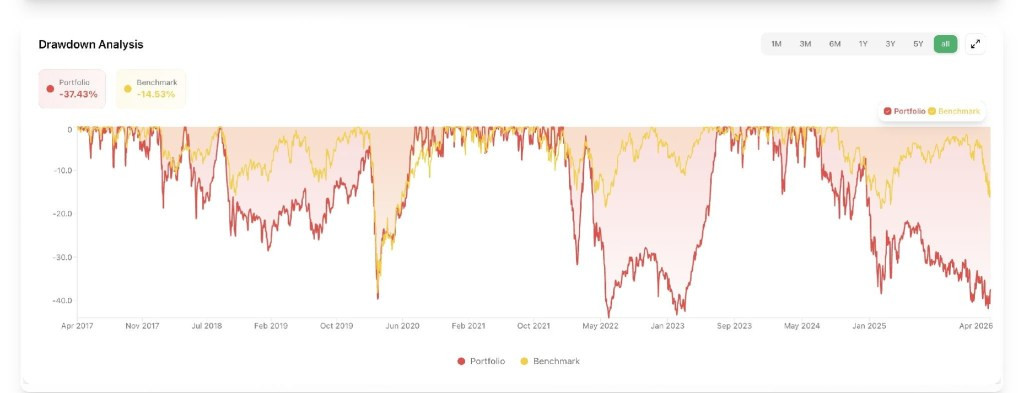
Drawdown analysis comparing a momentum portfolio against its benchmark across multiple market cycles — including the COVID crash of June 2020 and the 2022 correction.
Momentum doesn’t eliminate losses. It creates a structured process for handling them instead of reacting emotionally every single time markets become volatile.
Funny how long-term conviction gets quieter once stocks stop rising every week. That’s when investors usually discover what their actual risk tolerance is — not what they imagined it was when markets were calm.
It still requires discipline
Following a strategy sounds easy during strong markets. The difficult part begins once drawdowns arrive and every instinct tells you to abandon the system halfway through.
Many investors don’t fail because they lack information anymore. Information is everywhere now. They struggle because consistency becomes difficult once emotions get involved.
Why Tools Quietly Matter More Than People Think
Understanding the momentum conceptually is actually not that hard.
Implementing it properly every month is a different story.
Tracking hundreds of stocks manually, comparing rankings, filtering for liquidity, updating portfolios, checking exits and replacements — eventually it becomes difficult to manage consistently without some structure.
Some investors handle this through spreadsheets. Others prefer platforms built around systematic investing workflows.
Kalpi focuses heavily on rule-based investing and factor-driven portfolio building. The useful part for many retail investors isn’t really automation itself. It’s an organisation.
Because after a point, the challenge stops being: “Do I understand momentum?”
And becomes: “Can I realistically follow this process properly for years?”
That’s a much harder question. And honestly, probably the more important one too.
Responding, Not Predicting
The matka doesn’t try to outsmart summer. It simply responds steadily to what’s already happening around it.
Momentum investing works similarly. It’s less about predicting perfectly and more about responding consistently.
Most investing mistakes happen during emotional extremes — excitement near the top, fear near the bottom, endless second-guessing somewhere in the middle.
A clear framework doesn’t remove emotions entirely. But it usually reduces how much damage those emotions can do once markets become noisy.
And over long periods, that matters more than most investors initially realise.
Frequently Asked Questions
Is momentum investing risky?
Yes. Every equity strategy carries risk. Momentum can struggle sharply during sudden reversals because yesterday’s winners sometimes become tomorrow’s weakest stocks very quickly. That’s why position sizing and diversification still matter.
How often should someone rebalance a momentum portfolio?
Most retail investors usually prefer quarterly rebalancing because it’s easier to manage and keeps transaction costs lower. Monthly rebalancing reacts faster, but also creates more churn. There’s no perfect answer honestly. It depends on how active you want the strategy to be.
Does momentum work only during bull markets?
Not really. Momentum has historically shown results across different market environments, though the experience can vary a lot. Some phases feel smooth. Others become frustratingly choppy. That inconsistency is normal.
Is momentum better than value investing?
They’re solving different problems. Value investing tries to buy assets below perceived intrinsic worth. Momentum investing follows existing strength and market leadership. Some investors actually combine both approaches rather than treating them like opposites.
Can beginners realistically use momentum investing?
Yes, probably more easily than many advanced investing styles. But beginners usually underestimate the psychological side. The strategy only works if the rules continue being followed during uncomfortable periods too. That part matters more than finding the “perfect” momentum filter.
Source - https://kalpi.ai/blogs/momentum-investing-in-india-a-practical-guide-for-retail-investors


Comments
Post a Comment